How Many Arrows Are in a Quiver?
This guide contains affiliate links. As an Amazon Associate I earn from qualifying purchases. How affiliate links work.
By James Holbert · Explained Archery
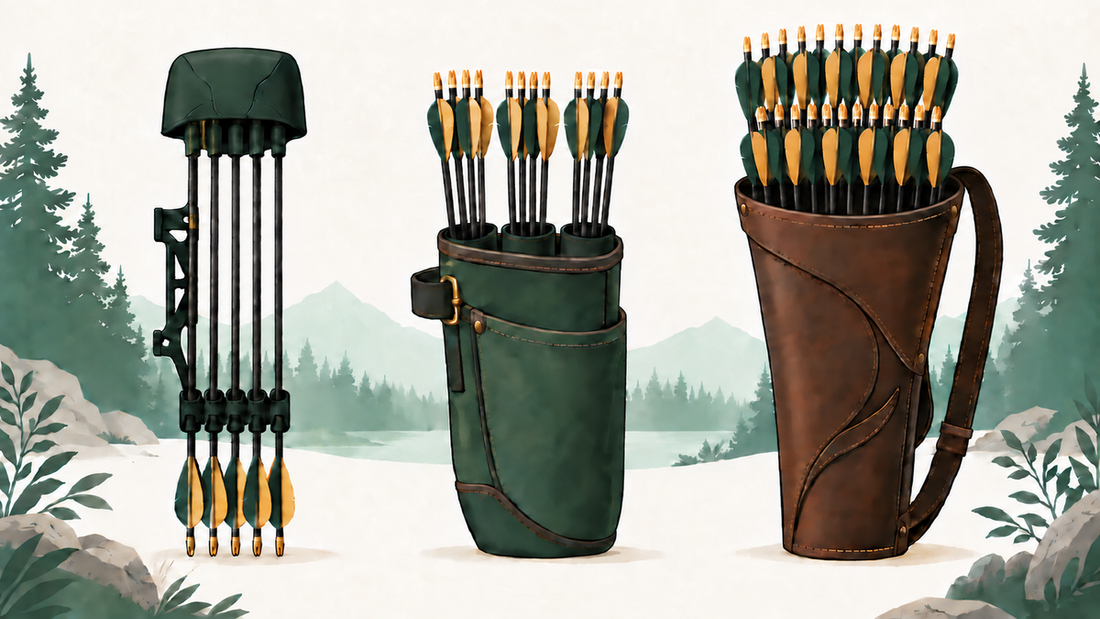
A quiver holds anywhere from 3 to 36-plus arrows, and the number depends entirely on the quiver type. A bow-mounted hunting quiver usually carries 3 to 7 arrows, a hip or side quiver carries 6 to 12, a back quiver carries 12 to 24 or more, and a bulk arrow tube can hold up to 36. There is no single fixed number, because a quiver is a piece of equipment, not a defined unit like a dozen.
Quick answer
How many arrows are in a quiver depends on what kind of quiver you mean. Most archers use one of these ranges as a rule of thumb:
- Bow-mounted quiver: 3 to 7 arrows.
- Hip or side quiver: 6 to 12 arrows.
- Back quiver: 12 to 24 or more.
- Field or target tube quiver: 6 to 12 arrows.
- Ground quiver: 12 or more, standing in a stake at your feet.
- Crossbow bolt quiver: 3 to 6 bolts.
- Arrow tube or hard case: 12 to 36, for transport and storage rather than shooting.
The full breakdown, with typical use for each, is in the table below. If you are building out a full setup rather than just a quiver, the archery equipment list covers everything else you need alongside it.
How many arrows does each quiver type hold?
| Quiver type | Typical capacity | Typical use |
|---|---|---|
| Bow-mounted quiver | 3 to 7 arrows | Bowhunting, keeps arrows attached and ready on the bow |
| Hip or side quiver | 6 to 12 arrows | Target practice and field archery, fast to draw from |
| Back quiver | 12 to 24 or more | Traditional and 3D archery, higher capacity, slower to draw from |
| Field or target tube quiver | 6 to 12 arrows | Range sessions and field courses, worn on the belt |
| Ground quiver | 12 or more | Stands at your feet on the shooting line, does not get worn |
| Crossbow bolt quiver | 3 to 6 bolts | Mounted to the crossbow rail or stock |
| Arrow tube or hard case | 12 to 36 arrows | Transport, air travel, and long-term storage, not for shooting from |
Capacity varies by brand, arrow diameter, and fletching size. Treat these as typical ranges, not fixed specs.
How many arrows is a quiver, historically?
There is a traditional answer to this question that predates modern gear entirely. Medieval English archers typically carried a sheaf of 24 arrows into battle, bundled and belted at the waist or carried in a simple back or hip quiver. That number, 24, is the closest thing archery history has to a standard quiver size, and it is why some older references still describe "a quiver" as 24 arrows.
In practice, an archer at a medieval battle could shoot through a sheaf in minutes and relied on resupply from wagons carrying spare arrows, so a single archer might go through 48 to 72 arrows or more over the course of an engagement. The quiver itself was never a strict capacity limit, it was a carrying tool, and archers refilled it as fast as pages and runners could bring more arrows forward. For more on the equipment and history behind traditional archery, see the Wikipedia entry on the quiver.
So if someone asks how many arrows are in a quiver and wants one historical number, 24 is the common traditional answer. If they mean a modern hip, back, or bow quiver, the answer depends on the type, as shown in the table above.
How many arrows should a beginner own?
A beginner shooting targets at a range does well with a dozen matched arrows. That is enough to shoot a full end without walking down early, enough to notice if one arrow groups differently from the rest, and enough spares if one gets damaged or lost in the grass. A dozen also matches how most arrows are sold, since manufacturers cut and fletch them in sets of 12.
A beginner bowhunter needs fewer, but they need to matter more. Six matched hunting arrows is a practical number: enough to sight in, practice broadhead groups, and still have a full quiver on opening day, without carrying more weight and noise into the field than you need.
Why matched arrows matter
Matched arrows share the same spine, length, weight, and fletching, which means they fly the same way out of the same bow. Mixing arrows of different spine or weight is one of the most common reasons beginners see inconsistent groups and think the problem is their form. Before you buy a dozen, confirm your spine and length with the arrow spine chart or the arrow spine calculator, and use how to determine arrow length and the arrow weight calculator to get the rest of the specification right before you order a full set. New to the sport generally, the beginner archery guide covers what to buy first and in what order.
How does quiver type change how many arrows you carry?
Capacity is not just a spec, it follows from how each quiver style is meant to be used.
Bow-mounted quivers
A bow quiver bolts to the riser or the accessory rail and holds arrows against the limb or stabilizer bar. It carries the fewest arrows of any style because every arrow adds weight and shifts balance out to one side of the bow. Bowhunters use these almost exclusively, since they keep every arrow attached to the bow and ready without reaching for a separate quiver.
Hip and side quivers
Hip quivers hang from a belt at your side and hold arrows point-down or point-up depending on the design. They carry more than a bow quiver, typically 6 to 12, and let you draw an arrow with one smooth motion, which is why most target and field archers use them.
Back quivers
A back quiver holds the most arrows of any commonly worn style, 12 to 24 or more, and spreads that weight across your shoulders instead of your hip. It is the traditional choice for 3D archery and longbow or recurve shooters who want to carry a full sheaf's worth without reaching for a resupply. The tradeoff is a slower, less consistent draw, since you are pulling an arrow from over your shoulder without seeing it.
Field and target tube quivers
These sit somewhere between a hip and back quiver, usually a rigid tube worn on the belt, holding 6 to 12 arrows upright and separated so fletching does not tangle. They are common on outdoor field courses and target lines where archers move between shooting positions.
Ground quivers
A ground quiver is a stand, often with a spike to push into turf or a flat base for indoor ranges, that holds 12 or more arrows upright at your feet. It does not get worn at all, which makes it a common choice for club practice, coaching sessions, and anyone shooting from a fixed spot for a long stretch.
Arrow tubes and hard cases
These are not shooting quivers at all, they are transport and storage containers. A tube or case can hold 12 to 36 arrows for a car trip, a flight, or off-season storage, protecting fletching and points that a worn quiver would expose.
Bowhunting quivers and broadheads
Bowhunting quivers need to do one more job than target quivers: keep sharp broadheads covered and controlled. Most bow-mounted hunting quivers use a rubber or foam hood that grips each broadhead individually, so blades stay covered while you carry the bow through brush and stay in place when you climb into a stand.
Because of that hood system and the balance concerns of a bow-mounted design, 3 to 5 arrows is the normal capacity for a hunting quiver, and most hunters do not fill it further even if it has room. Fewer, well-maintained broadhead-tipped arrows beat a full quiver of arrows you have not checked. Inspect broadheads for looseness or bent blades before every hunt, and never carry an arrow with an exposed, uncovered blade.
How many arrows should you carry per session?
Quiver capacity is the ceiling. How many arrows you actually carry depends on what you are doing that day.
| Activity | Typical arrows carried | Why |
|---|---|---|
| Target practice | 6 to 12 | A full end plus spares, without walking to retrieve too often |
| 3D archery | 6 to 12 | One course round between retrieving, plus a couple of spares for a lost or damaged arrow |
| Field archery | 6 to 12 | Matches the shots-per-target on most field courses, worn on a hip or tube quiver while walking the course |
| Bowhunting | 3 to 6 | Fewer, carefully inspected broadhead arrows, kept light and quiet in the stand or blind |
Carry what you can inspect and manage. Overfilling any quiver adds noise, weight, and rattling arrows.
Choosing a quiver: what to check
- Does it fit your bow, belt, or back comfortably with a full load of arrows?
- Does it hold your arrow diameter snugly, without rattling or falling out?
- If it is for hunting, does it cover broadheads fully and grip them securely?
- Can you draw an arrow smoothly and quietly in your shooting position?
- Does the capacity match what you actually carry per session, not the maximum the maker lists?
The right quiver is the one that stays secure and quiet at the capacity you actually use, not the one with the highest number on the box.
Related guides
These guides help you match arrows to your bow and figure out what else belongs on your equipment list.
Frequently asked questions
Short answers to the most common quiver capacity questions.
How many arrows in a quiver is normal?
A bow-mounted quiver normally holds 3 to 7 arrows, a hip quiver 6 to 12, and a back quiver 12 to 24 or more. There is no single normal number across all quiver types.
How many arrows can a quiver hold at maximum?
Large back quivers and arrow tubes can hold 24 to 36 arrows, but most archers do not fill a quiver to its physical maximum since it adds weight and makes arrows harder to manage.
How many arrows are in a full quiver historically?
A medieval English sheaf, the traditional unit for a fully loaded quiver, held 24 arrows. Archers in battle often went through several sheaves with resupply.
How many arrows should a beginner buy?
A dozen matched arrows for target practice, or six matched arrows for bowhunting. Confirm spine, length, and weight before buying a full set.
How many arrows fit in a bow quiver?
Most bow-mounted quivers hold 3 to 7 arrows. Bowhunting quivers typically carry 3 to 5 broadhead-tipped arrows to keep the bow balanced and the hood covering blades properly.
Does a crossbow quiver hold as many arrows as a bow quiver?
Crossbow bolt quivers usually hold fewer, typically 3 to 6 bolts, since they mount to the rail or stock and add weight directly in front of the shooter's grip.
References
These sources support the guidance on this page.