Arrow Spine Chart
This guide contains affiliate links. As an Amazon Associate I earn from qualifying purchases. How affiliate links work.
By James Holbert · Explained Archery
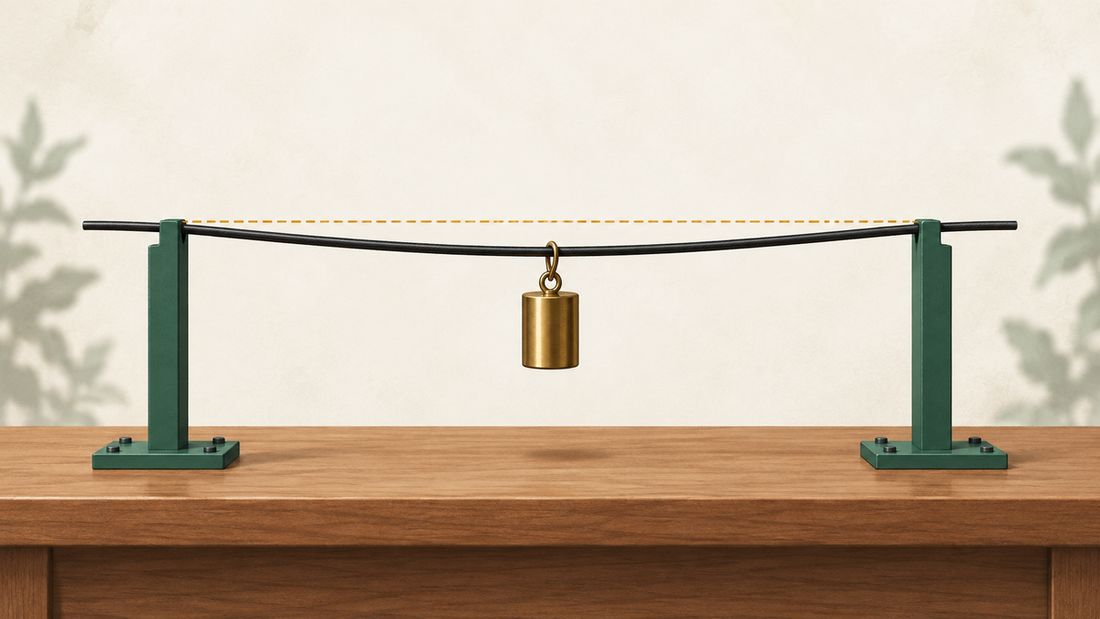
An arrow spine chart tells you how stiff your arrow shaft should be for your draw weight, arrow length and point weight. Spine is static stiffness: the shaft is supported 28 inches apart, a 1.94 lb weight hangs from the middle, and the sag in thousandths of an inch is the number on the shaft, so a 400 spine is stiffer than a 500. The charts below give a starting spine for compound, recurve and traditional bows, the arrow spine calculator does the same math for your exact numbers, and bare-shaft or paper tuning helps check the setup.
Quick answer
Find your bow type, draw weight band and cut arrow length in the matching table below. The cell is your starting carbon spine with a 100 gr point. A 50 lb compound with a 28" arrow lands on 400; a 40 lb recurve with a 28" arrow lands on 600 to 700; a 45 lb longbow with a 28" arrow and a 125 gr point lands on 500. Lower number means stiffer shaft. Longer arrows and heavier points need a stiffer spine, and finger shooters need a weaker spine than a compound shooter with a release aid at the same weight.
How do you read an arrow spine chart?
Every spine chart needs the same three inputs.
1. Draw weight
For a compound, use peak draw weight. For a recurve or longbow, use the weight the bow pulls at your draw length, not the limb marking: limbs are marked at 28 inches and each inch beyond adds roughly 2 to 3 lb, so a 40 lb recurve drawn to 30 inches pulls about 45 lb. See how to measure bow draw weight.
2. Arrow length
Chart arrow length is the cut length of the shaft, nock throat to end of shaft, without the point. It is not your draw length; most archers cut arrows 1 to 2 inches longer than that. First measure your draw length (or use the draw length calculator), then see how to determine arrow length or the arrow length calculator.
3. Point weight
The tables assume a 100 gr point. Heavier points make the arrow act weaker and push you toward a stiffer spine.
The adjustments that move you across the chart
- Arrow length: every inch beyond 28 inches acts like about 3 to 5 lb more draw weight; every inch under acts like 3 to 5 lb less.
- Point weight: every 25 gr above 100 gr acts like about 3 lb more draw weight.
- Release style: fingers push the string sideways, so the arrow must bend around the riser. A recurve or traditional shooter needs a weaker spine than a compound shooter with a release aid at the same weight, usually one to two sizes. That is why there are three tables.
Arrow spine chart for compound bows (release aid)
Use peak draw weight and cut arrow length. Fast compounds with aggressive cams sit at the stiff end of each cell; slower bows can drop one size weaker.
| Arrow length | 30–40 lb | 40–50 lb | 50–60 lb | 60–70 lb | 70–80 lb |
|---|---|---|---|---|---|
| 26" | 700 | 600 | 500 | 400 | 340 |
| 27" | 700 | 600 | 500 | 400 | 340 |
| 28" | 600 | 500 | 400 | 340 | 300 |
| 29" | 600 | 500 | 400 | 340 | 300 |
| 30" | 500 | 400 | 340 | 300 | 250 |
| 31" | 500 | 400 | 340 | 300 | 250 |
Starting point only, based on typical manufacturer charts with a 100 gr point. Confirm on the chart for your exact shaft (Easton, Gold Tip, Victory, Black Eagle) because deflection differs by shaft model.
Arrow spine chart for recurve bows (fingers)
Use bow weight at your draw length. Light Olympic-style setups need 900 to 1200 spines that only target arrow lines make.
| Arrow length | 20–28 lb | 28–34 lb | 34–40 lb | 40–46 lb | 46–52 lb |
|---|---|---|---|---|---|
| 26" | 1200 | 1000 | 900 | 700 | 600 |
| 27" | 1100 | 1000 | 800 | 700 | 600 |
| 28" | 1000 | 900 | 700 | 600 | 500 |
| 29" | 1000 | 800 | 700 | 600 | 500 |
| 30" | 900 | 800 | 600 | 500 | 400 |
| 31" | 900 | 700 | 600 | 500 | 400 |
Starting point only, based on typical manufacturer charts with a 100 gr point. Confirm on the chart for your exact shaft (Easton, Gold Tip, Victory, Black Eagle) because deflection differs by shaft model.
Arrow spine chart for traditional bows and longbows (fingers, off the shelf)
Traditional bows are shot off the shelf with fingers, usually with a 125 to 145 gr point, which is built into this table. If your longbow has no sight window, lean one size weaker.
| Arrow length | 30–35 lb | 35–40 lb | 40–45 lb | 45–50 lb | 50–55 lb |
|---|---|---|---|---|---|
| 26" | 800 | 700 | 600 | 600 | 500 |
| 27" | 700 | 700 | 600 | 500 | 500 |
| 28" | 700 | 600 | 500 | 500 | 400 |
| 29" | 600 | 600 | 500 | 400 | 400 |
| 30" | 600 | 500 | 400 | 400 | 340 |
| 31" | 500 | 500 | 400 | 340 | 340 |
Starting point only, based on typical manufacturer charts with a 125 gr point. Confirm on the chart for your exact shaft (Easton, Gold Tip, Victory, Black Eagle) because deflection differs by shaft model.
Point weight adjustment: how much does a heavier point change spine?
A step means one spine size on the chart, such as 500 to 400. When unsure, err stiff on a compound and weak on a recurve.
| Point weight | Acts like | Chart adjustment |
|---|---|---|
| 75 gr | About 3 lb less | One step weaker if you sit at the bottom of a band; otherwise no change |
| 100 gr | Chart baseline | No change |
| 125 gr | About 3 lb more | No change unless you are near the top of a band; then one step stiffer |
| 150 gr | About 6 lb more | One step stiffer (for example 500 to 400) |
| 175 gr | About 9 lb more | One step stiffer, two if near the top of a band |
| 200 gr | About 12 lb more | Two steps stiffer, then bare-shaft test |
Each 25 gr shifts effective draw weight by about 3 lb. Heavier points also raise front of center; check it with the arrow FOC calculator.
Aluminum spine numbers (2016, 2117, 2314): what do they mean?
Aluminum arrows use a four-digit code: the first two digits are the outside diameter in 64ths of an inch, the last two the wall thickness in thousandths. A 2117 is 21/64 inch across with a 0.017 inch wall. Bigger diameter or thicker wall means stiffer, so a 2117 is stiffer than a 2016.
| Aluminum size | Diameter (64ths) | Wall (in) | Approx. carbon spine |
|---|---|---|---|
| 2013 | 20/64 | 0.013 | 700 |
| 2016 | 20/64 | 0.016 | 600 |
| 2114 | 21/64 | 0.014 | 600 |
| 2117 | 21/64 | 0.017 | 500 |
| 2213 | 22/64 | 0.013 | 500 |
| 2216 | 22/64 | 0.016 | 400 |
| 2314 | 23/64 | 0.014 | 400 |
| 2315 | 23/64 | 0.015 | 340 |
| 2413 | 24/64 | 0.013 | 340 |
| 2512 | 25/64 | 0.012 | 300 |
Approximate matches; aluminum is heavier than carbon at the same spine. Confirm on Easton's chart for your alloy shaft.
Gold Tip, Easton and Victory charts: why do the numbers differ?
Look up a 60 lb compound with a 29" arrow on three brand charts and you may get 340 from one and 300 from another. None of them is wrong.
- Each chart is built for that maker's shafts. A 400 measures 0.400 inch everywhere, but weight per inch and diameter differ by model.
- Different speed assumptions. Easton's selector groups compound bows by rated speed; faster bows push the recommendation stiffer.
- Different point weight baselines. Some charts assume 100 gr, some give a 125 gr column.
- Different safety margins. Hunting charts lean stiff; recurve charts lean weak.
Use the tables here to see where you sit, then buy the size your shaft maker recommends: Easton's shaft selector, the Gold Tip selector, the Victory arrow guide or the Black Eagle charts. If two brands disagree by one size, pick the stiffer for a compound and the weaker for a recurve.
Worked example: 29" arrow, 55 lb compound, 125 gr point
- Draw weight: 55 lb.
- Arrow length: 29" is one inch over 28", so add about 4 lb. Total 59 lb.
- Point weight: 125 gr is 25 gr over 100 gr, so add about 3 lb. Effective draw weight is about 62 lb, the same figure the arrow spine calculator gives for this setup.
- Read the compound table at 60 to 70 lb and 28" (length is already counted): 340 spine.
Reading the 29" row directly at 55 lb gives 400, at the very edge of the band, and the heavier point pushes you over it. 340 is the safer buy because a slightly stiff arrow tunes easily on a compound. Confirm the exact shaft on its manufacturer's chart, test a small batch using the appropriate tuning method, and preserve safe arrow length.
Weak vs stiff: what do you see on the target?
A spine mismatch is a sideways error that stays even when your form is steady. For a right-handed recurve or traditional shooter, a weak arrow bends too far around the riser and tends to hit right of the group; a stiff arrow tends to hit left. Swap the directions for a left-handed archer. A compound with a release aid is much less sensitive because the string travels straight forward, so trust the paper tear instead.
Before you blame spine, rule out grip torque, anchor and release. See why arrows go left or right.
How do you check spine after you pick it?
Two tests confirm a chart result. Do them at 10 to 15 yards with a solid backstop before cutting the whole set.
Bare shafts skip further than fletched ones when they miss, so shoot them only at close range into a good target.
Use the arrow spine calculator
Enter bow type, draw weight, cut arrow length and point weight and the arrow spine calculator applies the adjustments from this page and returns a recommended spine plus the next size up and down. Pair it with the arrow weight calculator to see the finished arrow weight.
- Chart from cut arrow length, never from draw length alone.
- Use bow weight at your draw length for recurve and traditional bows.
- Buy a small batch and bare-shaft test before cutting a dozen.
The calculator gives a starting point. The target has the final say.
Related guides
The measurements the chart depends on, plus the arrows hub.
Frequently asked questions
Short answers to common arrow spine chart questions.
What spine do I need for a 50 lb compound bow?
With a 28" arrow and a 100 gr point, a 50 lb compound starts at 400 spine. Go to 340 if the arrow is 30 inches or longer or the point is 150 gr; a 27" arrow can use 500.
What spine do I need for a 40 lb recurve bow?
A 40 lb recurve with a 28" arrow starts at 600 to 700 spine. Use the weight at your draw length: a 40 lb limb drawn to 30 inches pulls about 45 lb and moves you to 500 or 600.
Is 400 or 500 spine stiffer?
400 is stiffer. The number is deflection in thousandths of an inch under a standard load, so a 400 shaft bends less than a 500.
What happens if arrow spine is too weak or too stiff?
A weak arrow bends too much, flies nock-sideways, groups poorly and can be unsafe on a heavy bow. A stiff arrow is harder to tune and hits to one side. Slightly stiff is the safer error on a compound; slightly weak tunes more easily on a recurve.
Does arrow length change spine?
Yes. The printed static spine stays the same, but a longer arrow flexes more and acts weaker. Each inch over 28 inches acts like 3 to 5 lb more draw weight.
What spine do I need for a traditional bow or longbow?
For a 45 lb longbow at your draw length with a 28" arrow and a 125 gr point, start at 500 spine; a 40 lb bow starts at 600 and a 50 lb bow at 400 to 500.
Can I use the same arrow spine chart for every brand?
It gets you close, because the deflection test is standard, but each brand writes its chart around its own shafts. Confirm the size on the chart for the exact shaft you buy, then bare-shaft test it.
References
These sources support the guidance on this page.