Backyard Archery Safety
This guide contains affiliate links. As an Amazon Associate I earn from qualifying purchases. How affiliate links work.
By James Holbert · Explained Archery
Backyard practice
Quick answer: backyard archery is only worth doing if local rules allow it and you can build a real safe lane, a proper target, and a backstop that stops misses. If you cannot control people, pets, neighbors, and the space behind the target, use a range or club instead.
There is no universal legal answer. Check city or county rules, HOA or rental rules, and any property restrictions before you shoot at home.
Check local rules first
Start with the rules that apply to your address. A backyard that works in one place may be off-limits in another. Read the local ordinances, the property agreement, and any HOA rules. If you are unsure, choose a range, club, or coached session instead of guessing.
- Check city and county rules.
- Check HOA, rental, or property rules.
- Do not treat a fence or line of shrubs as legal clearance.
- Use a range or club if the rules are unclear.
Backyard safety checklist
- Local rules checked
- Safe target in place
- Real backstop behind the target
- Clear shooting lane
- No people or pets nearby
- Arrows inspected
- Distance kept under control
- Safe storage after practice
Safe target and backstop
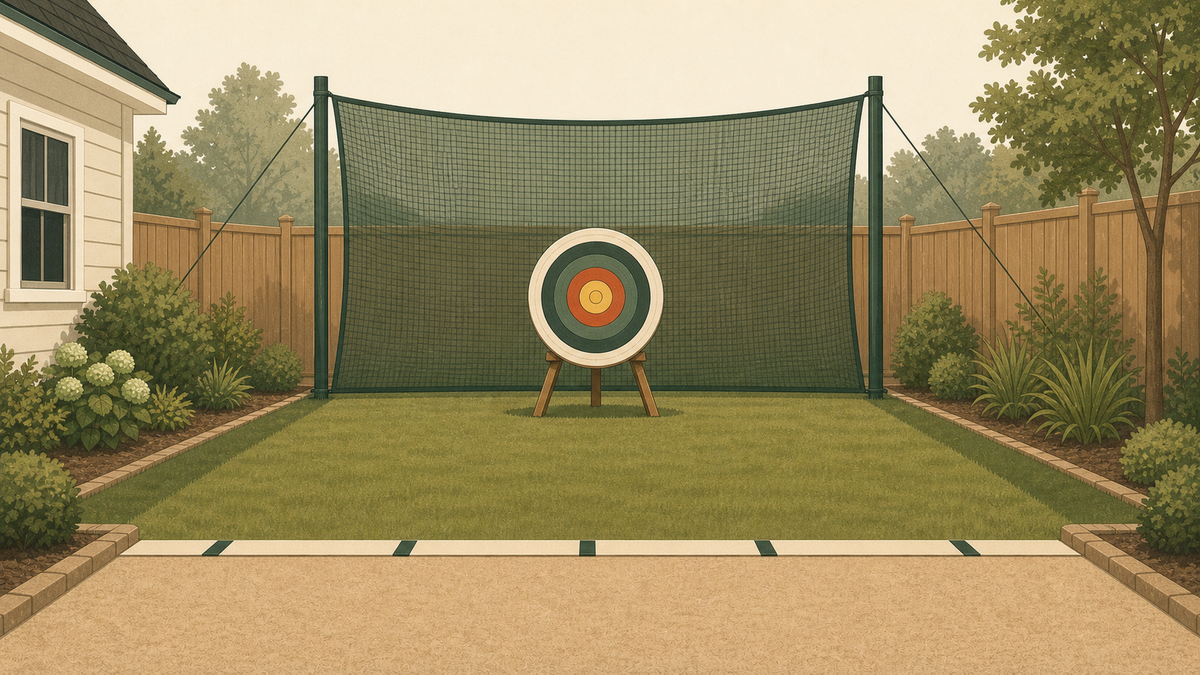
Use a proper archery target and a backstop that can stop misses. The backstop must do more than catch the arrows that hit the middle. It needs to cover the miss zone too. Do not rely on a fence, shed wall, plywood sheet, bush, or hedge alone. Always know what is behind the target.
- Use a target built for archery arrows.
- Put a real backstop behind the target face.
- Check for wear before each session.
- Keep the stop tall and wide enough for misses.
Shooting lane and surroundings
The safe lane matters as much as the target. Do not shoot if a road, sidewalk, window, house, pet, animal, or unknown backdrop is in the line or the miss zone. Stop the session if anyone walks into the area. Poor light, glare, or rain can also make the lane harder to judge.
Beginner distance
Start close enough that every arrow stays under control and you can see the group clearly. Increase distance only when the groups are steady and the backstop still fits the setup. For a simple starting guide, use Archery Target Distance Chart. For aiming basics, read How to Aim a Bow.
Equipment safety
Inspect arrows before every session. Do not shoot damaged shafts, cracked nocks, loose points, or arrows that do not match the bow setup. Never dry fire a bow. Store the bow and arrows after practice so children and visitors cannot handle them without supervision.
- Inspect arrows before shooting.
- Do not use damaged shafts or components.
- Match arrows to the bow setup.
- Never dry fire.
- Store the equipment after practice.
Children, pets, and visitors
Do not allow unsupervised access to the bow or arrows. Keep pets indoors or well away from the lane. Pause practice if anyone else is nearby. Put the gear away when the session ends so nothing is left where a child or visitor can pick it up.
Safer alternatives
If the yard is too small or the layout is awkward, a range is the cleaner choice. A club, beginner class, coached session, or indoor range can solve more problems than a crowded backyard can.
- Archery range
- Archery club
- Beginner class
- Coached session
- Indoor range where available
Related beginner guides
Use these pages to keep the beginner path in one place.
Buying guide: Best Archery Target and Backstop.
Frequently asked questions
Short answers for common backyard safety questions.
Is backyard archery safe?
It can be safe only if the rules allow it and the target, backstop, lane, and surroundings are controlled. If you cannot control the space, use a range.
Is it legal to shoot a bow in your backyard?
Sometimes, but not everywhere. Check local laws, HOA rules, rental rules, and property restrictions first. There is no universal answer.
What is a safe backstop for backyard archery?
A real archery backstop that fits the bow setup and can stop misses. A fence, shed, hedge, or thin board is not enough on its own.
How far should beginners shoot in a backyard?
Start close enough to keep every shot under control. If the groups are not steady, stay close and work on form instead of moving back.
Can a fence stop an arrow?
Do not assume it can. Fences vary too much in material, age, and thickness to count as a reliable backstop.
Should children practice backyard archery?
Only with direct adult supervision and only if the whole area is set up safely. If the space is not controlled, use a club or range.
What should I do if my yard is too small?
Use a range, club, coached session, or indoor facility where available. Small yards are often better for storage and dry practice than live shooting.
References
These references support the safety guidance used here.