Crossbow Bolt Weight and Length Chart
This guide contains affiliate links. As an Amazon Associate I earn from qualifying purchases. How affiliate links work.
By James Holbert · Explained Archery
A crossbow bolt weight chart starts with one number: the minimum total bolt weight in your manual, usually 350 to 400 grains including the point. Most hunting bolts land between 400 and 450 grains and 20 inches long, with 16 to 18-inch bolts for compact and reverse-draw crossbows and 20 to 22-inch bolts for recurve models. Heavier bolts fly slower but hit with more momentum and less noise, and every bolt in your quiver should match within 2 to 3 grains.
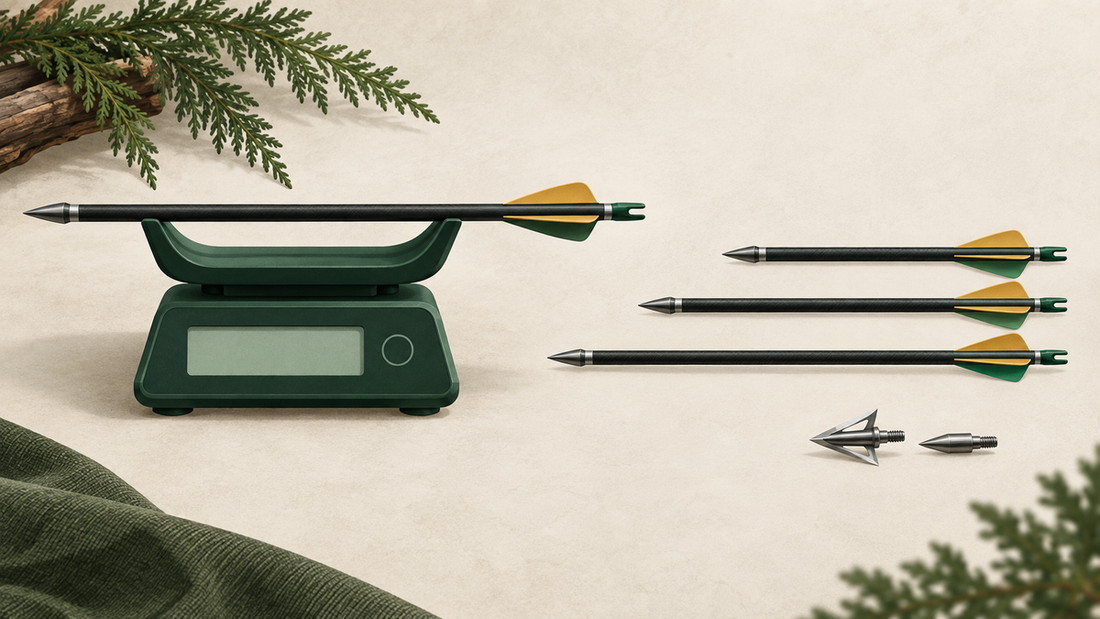
Quick answer
Crossbow bolts are chosen by total weight and length, not by spine or grains per pound the way vertical bow arrows are. The manual for your crossbow sets a minimum bolt weight and a minimum bolt length. Stay at or above both. Within those limits, a heavier bolt is quieter and carries more momentum, while a lighter bolt is faster and flatter.
- Minimum weight: usually 350 to 400 grains total, point included. Never go under it.
- Typical hunting weight: 400 to 450 grains total with a 100-grain point.
- Common lengths: 16, 18, 20 and 22 inches, set by the crossbow's rail and power stroke.
- Matching: weigh every bolt and keep the set within 2 to 3 grains.
The tables below give typical ranges. Your manual and the bolt maker's spec sheet always win if they differ. Once your bolts are sorted, our guide on how to sight in a crossbow scope shows how to zero with them.
What are the parts of a crossbow bolt?
A bolt is short and stiff, but it has the same parts as an arrow. Knowing the names helps when you read a spec sheet or a weight chart.
- Shaft. Carbon or aluminum tube. Its weight is listed in grains per inch (GPI). A 20-inch shaft at 13 GPI weighs 260 grains before anything is added.
- Insert. A threaded metal sleeve glued into the front of the shaft. Standard inserts weigh about 15 to 30 grains. Brass inserts can weigh 50 grains or more and push weight forward.
- Field point or broadhead. Screws into the insert. 100 grains is the most common, 125 grains is the usual heavier choice.
- Vanes. Three plastic vanes, usually 2 to 4 inches long, about 6 to 10 grains each. They steer the bolt and add a little drag.
- Nock. The rear fitting that meets the string. This is where crossbows differ most from vertical bows.
Crossbow nock types
| Nock type | Shape | Used by |
|---|---|---|
| Flat | Flat rear face, no groove | Many recurve crossbows and older compound models |
| Half-moon | Shallow curved groove that must line up with the string | Many compound crossbows; vane orientation matters |
| Capture (lighted or plain) | Deep groove that holds the string | Several compound models; check the manual |
| Omni | Multi-groove nock that fits at any rotation | Some TenPoint and Wicked Ridge models |
| Alpha | Deep ring-style nock with a fixed orientation | Newer TenPoint crossbows |
Use only the nock your manual lists. The wrong nock can slip under the string and cause a dry fire. Our guide on how to change nocks on crossbow bolts covers the swap.
Why does total bolt weight matter?
A crossbow limb stores a fixed amount of energy. The bolt's job is to absorb that energy and carry it downrange. A bolt that is too light cannot absorb it all, so the rest goes back into the limbs, string, cams and rail. Makers describe the result as dry-fire-like damage: cracked limbs, stretched cables and broken cams. That is why every manual sets a minimum total bolt weight, and why shooting under it voids the warranty on most crossbows.
The minimum is usually 350 to 400 grains with the point installed. Some high-speed models list 400 grains or more. Above the minimum, you choose weight based on what you want the bolt to do.
| Class | Total weight (with point) | What you get | Trade-off |
|---|---|---|---|
| Light | 350 to 400 gr | Highest speed, flattest trajectory, most forgiving of range error | More noise and vibration, less momentum, closest to the minimum limit |
| Standard | 400 to 450 gr | Balanced speed and penetration, matches most factory bolts | Slightly more drop than light bolts |
| Heavy | 450 to 500 gr and above | Quietest shot, most momentum, best penetration on large game | More drop past 30 yards, so range estimation matters more |
Typical crossbow bolt weight chart. Never choose from the light column if it puts you below your manual's minimum.
If you have ever read about dry firing a compound bow, the same physics applies here, just with more stored energy.
What length crossbow bolt do you need?
Bolt length is set by the crossbow, not by you. The bolt has to be long enough for the point to sit ahead of the rail and the arrow rest when the bolt is seated against the string. Too short, and the broadhead or the insert can hit the rail or the rest on the shot.
| Bolt length | Typical crossbow class | Notes |
|---|---|---|
| 16 inches | Compact and reverse-draw compound crossbows | Short power stroke; often paired with a specific nock |
| 18 inches | Compact and mid-size compound crossbows | Common with narrow-limb designs |
| 20 inches | Full-size compound crossbows, many recurve crossbows | The most common length; widest bolt selection |
| 22 inches | Recurve crossbows and some older full-size compounds | Longer power stroke needs the extra length |
Crossbow bolt length chart by class. Length is measured from the throat of the nock to the end of the shaft, without the point.
Never shoot a bolt shorter than the manual's minimum
- The point must clear the front of the rail and the arrow rest with the bolt fully seated on the string.
- A short bolt can strike the rail or rest, break the shaft, or release the string with nothing to push, which is a dry fire.
- Do not cut factory crossbow bolts shorter. Buy the length the manual lists.
- If a bolt is a different length than your old set, re-zero the scope before hunting.
Length limits are safety limits, not tuning suggestions.
How does bolt weight change speed, energy and momentum?
The speed on the box was measured with the lightest bolt the maker allows, often 400 grains. Add weight and the speed falls, but the energy does not fall with it. A heavier bolt leaves the crossbow slower, yet carries slightly more kinetic energy and clearly more momentum, because the limbs transfer energy more efficiently into a heavier load.
The table uses a crossbow rated at 400 fps with a 400-grain bolt and assumes a loss of about 3 fps for every extra 10 grains. Kinetic energy is weight times speed squared divided by 450,240. Momentum is weight times speed divided by 225,218.
| Total bolt weight | Speed | Kinetic energy | Momentum |
|---|---|---|---|
| 350 gr | about 415 fps | 134 ft-lb | 0.64 slug-fps |
| 400 gr | about 400 fps | 142 ft-lb | 0.71 slug-fps |
| 450 gr | about 385 fps | 148 ft-lb | 0.77 slug-fps |
| 500 gr | about 370 fps | 152 ft-lb | 0.82 slug-fps |
| 550 gr | about 355 fps | 154 ft-lb | 0.87 slug-fps |
Speed vs bolt weight for a 400 fps crossbow. Enter your own bolt weight and speed in the arrow kinetic energy calculator to get exact numbers.
Notice the pattern. Going from 400 to 500 grains costs about 30 fps, which adds roughly 5 inches of drop at 40 yards, but momentum climbs by about 15 percent. For deer-sized game at 20 to 30 yards, any row in the table has more than enough energy. For elk, bear or long shots, hunters usually move toward the heavier rows. Our guide on how far a crossbow will shoot puts those numbers into real hunting ranges.
Why isn't grains per pound used for crossbow bolts?
With a vertical bow, the rule of thumb is at least 5 grains of arrow weight for every pound of draw weight. A 60-pound compound bow needs a 300-grain arrow or heavier. That rule does not transfer to crossbows for two reasons.
- Draw weight is not the whole story. A crossbow may have a 200-pound draw weight but only a 10 to 15-inch power stroke, so the energy stored per pound of draw is very different from a compound bow with a 25-inch power stroke. Two crossbows with the same draw weight can store very different energy.
- The maker has already done the math. Crossbow companies test each model and publish a minimum bolt weight that keeps the bow safe. That figure replaces the grains-per-pound rule. Follow the minimum, then pick a weight above it.
If you want to calculate the weight of a custom bolt build before you buy components, the arrow weight calculator adds up shaft, insert, vanes, nock and point for you.
Do crossbow bolts have a spine, and what FOC should they have?
Spine
Spine is how much a shaft bends under load. Vertical bow arrows are chosen by spine because the arrow must flex around the riser. A crossbow bolt sits in a rail and is pushed straight from behind, so bolt makers build them very stiff and do not sell them by spine number. Most crossbow bolts fall around a 0.140 to 0.170-inch static spine, far stiffer than a typical hunting arrow. You choose by length and weight and let the maker handle stiffness. Our arrow spine chart explains the concept if you also shoot a vertical bow.
Front of center (FOC)
FOC is how far the balance point sits ahead of the middle of the bolt. Crossbow bolts typically run 10 to 15 percent FOC with a 100-grain point and a standard insert. Higher FOC steadies the bolt and helps broadheads fly like field points. Moving to a 125-grain point or a brass insert raises FOC a few points and adds total weight at the same time. Use the arrow FOC calculator to check a build before you glue inserts.
How do you weigh and match crossbow bolts?
Factory bolts are sold to a weight tolerance, often plus or minus 1 to 3 grains per shaft. Add inserts, nocks and points from different batches and a six-pack can vary by 10 grains or more. That spread shows up as vertical stringing at 40 yards.
- Buy a grain scale. Any digital scale that reads to 0.1 grain is fine.
- Weigh each finished bolt with the field point installed. Write the weight on the shaft with a marker.
- Group bolts within 2 to 3 grains of each other. Keep the outliers for practice, not for hunting.
- Weigh your broadheads too. A pack of 100-grain heads can vary by 2 to 4 grains. Pair the heaviest heads with the lightest shafts.
- Spin-test each bolt on a flat surface or a spin tester. A wobbling point means a bent insert or a damaged shaft.
Carbon vs aluminum crossbow bolts
Almost all new crossbows ship with carbon bolts, but aluminum is still sold and works well on lower-speed and recurve crossbows.
| Feature | Carbon bolts | Aluminum bolts |
|---|---|---|
| Typical weight | 380 to 450 gr finished | 420 to 500 gr finished |
| Straightness | 0.001 to 0.006 in | 0.002 to 0.005 in |
| Durability | Does not bend; can crack or splinter on hard impact | Bends on impact and stays bent |
| Speed | Faster, lighter shafts | Slower, heavier shafts |
| Noise | Louder on light builds | Quieter due to weight |
| Cost | Higher per bolt | Lower per bolt |
| Safety check | Flex and listen for cracks before every shot | Roll on a flat surface to find bends |
A cracked carbon bolt can shatter on release. Retire any carbon shaft that has hit a rock, a rail or another bolt.
What broadhead weight should you use on a crossbow?
Use 100 or 125-grain broadheads, and use field points of the same weight for practice. A 100-grain point is the default and keeps most factory bolts near 400 to 420 grains. Moving to 125 grains adds 25 grains, raises FOC and momentum, and costs about 7 to 8 fps. Either works. What matters is that the practice point and the hunting head weigh the same, so your zero carries over.
Crossbow-specific broadheads are built with shorter, stronger ferrules and blades because bolts hit harder and spin faster than arrows. Standard vertical bow heads usually fit the same insert thread, but check that the maker rates them for crossbow speeds.
Replacing nocks and points
Nocks wear, crack and sometimes get pushed into the shaft by the string. Inspect them before every session and replace any that are chipped or loose. Points and inserts can work loose too; a quarter turn with pliers before you load is a good habit. See how to change nocks on crossbow bolts for the full procedure, and remember to decock the crossbow before you inspect anything near the rail. Our guide on how long a crossbow can stay cocked explains why.
Related guides
These pages cover the rest of setting up and shooting a crossbow.
Frequently asked questions
Quick answers on crossbow bolt weight, length and matching.
How heavy should a crossbow bolt be?
At least the minimum in your manual, usually 350 to 400 grains including the point. Most hunters shoot 400 to 450 grains total. Go heavier, up to 500 grains or more, if you want a quieter shot and more penetration.
Does crossbow bolt weight include the point?
Yes. Minimum bolt weight in a manual always means the finished bolt with the field point or broadhead installed. A 300-grain shaft plus a 100-grain point is a 400-grain bolt.
What length bolts does my crossbow use?
Check the manual. Compact and reverse-draw crossbows usually use 16 or 18-inch bolts, full-size compounds use 20-inch, and recurve crossbows use 20 or 22-inch. Never go shorter than the listed length.
Can I use 22-inch bolts in a 20-inch crossbow?
Only if your manual lists 22 inches as an approved length. Shorter is the more dangerous direction because the point can sit behind the rail, but longer is not automatically safe either: many crossbows with an anti-dry-fire or bolt retention system need the bolt within a set length range for the mechanism to work. The extra 2 inches also adds about 20 to 30 grains and slows the bolt slightly. Check the manual before you change length in either direction.
Does a heavier bolt hit harder?
It carries more momentum and slightly more kinetic energy, so it penetrates better even though it is slower. The cost is more drop past 30 yards, so you need to know your distances.
Do I need to match crossbow bolts by weight?
Yes. Weigh each finished bolt on a grain scale and keep the hunting set within 2 to 3 grains. Bolts that differ by 10 grains or more will string vertically at 40 yards.
Are 100 or 125-grain broadheads better for a crossbow?
Both work. 100 grains is the standard and keeps speed up. 125 grains adds momentum and FOC at a cost of about 7 to 8 fps. Practice with field points of the same weight either way.
References
These sources support the guidance on this page.