Minimum Draw Weight for Bow Hunting
This guide contains affiliate links. As an Amazon Associate I earn from qualifying purchases. How affiliate links work.
By James Holbert · Explained Archery
Where a legal minimum draw weight for bow hunting exists, it mostly falls between 30 and 45 pounds for deer. The practical minimum is a little higher: about 40 pounds for whitetail with a modern compound, and 45 to 50 pounds with a recurve or longbow. Elk, moose and bear call for 50 to 60 pounds or more. Some states set no minimum, and many regulate arrow weight, broadhead width, let-off or crossbow draw weight too, so the exact rule comes from your state wildlife agency.
Quick answer
The minimum draw weight for bow hunting has two answers: the legal one and the practical one.
- Legal minimums are set state by state. Where they exist they mostly sit between 30 and 45 pounds for deer, measured at 28 inches or at your own draw length. Some states set none.
- Practical minimums for a clean kill on whitetail are about 40 pounds with a compound and 45 to 50 pounds with a recurve or longbow, shooting a sharp broadhead at sensible distances.
- Larger game such as elk, moose and bear needs 50 to 60 pounds or more.
- Other rules often ride alongside: minimum arrow length or weight, minimum broadhead width, a let-off cap, and crossbow minimums commonly between 75 and 125 pounds.
Draw weight only matters because it produces arrow energy, and that is what decides penetration. Our arrow kinetic energy calculator turns your setup into a figure you can compare with the table below.
What draw weight do you need for each animal?
These are practical recommendations for a hunter with good form, a tuned arrow and a sharp broadhead, shooting inside their effective range. They are not legal minimums.
| Game | Compound | Recurve or longbow | Kinetic energy target |
|---|---|---|---|
| Small game (rabbit, squirrel, grouse) | 25 to 35 lb | 30 to 40 lb | Under 25 ft-lb |
| Turkey | 35 to 45 lb | 40 to 50 lb | 25 to 41 ft-lb |
| Whitetail and mule deer, antelope | 40 to 50 lb | 45 to 55 lb | 25 to 41 ft-lb |
| Wild boar | 50 to 60 lb | 50 to 60 lb | 42 to 65 ft-lb |
| Black bear | 50 to 60 lb | 50 to 60 lb | 42 to 65 ft-lb |
| Elk | 55 to 65 lb | 55 to 65 lb | 42 to 65 ft-lb |
| Moose | 60 to 70 lb | 60 lb and up | 65 ft-lb and up |
Traditional bows need more draw weight for the same energy because they store and release it less efficiently than a compound.
The recurve column runs higher because a 45 pound recurve or longbow produces roughly the energy of a 35 to 40 pound compound. Our recurve versus longbow comparison covers why. For a first hunting bow, the bow draw weight chart matches draw weight to body size and experience.
Why is draw weight not the number that matters most?
Draw weight is the easiest number to read off a bow, which is why laws use it. But the animal feels an arrow of a certain weight arriving at a certain speed with a certain broadhead in a certain place. Five things decide the result:
- Arrow weight. A heavier arrow carries more momentum and penetrates better through bone. A 40 pound bow with a 400 grain arrow often out-penetrates a 50 pound bow with a 300 grain arrow. The arrow weight calculator gives your total.
- Arrow speed. Comes from draw weight, draw length and bow efficiency. A longer draw stores more energy at the same peak weight.
- Broadhead. A sharp fixed-blade head needs far less energy to penetrate than a large mechanical head that spends energy opening.
- Shot placement. A 40 pound arrow through both lungs kills quickly. A 70 pound arrow in the shoulder blade may not.
- Distance. A light bow that is adequate at 15 yards is not adequate at 35.
Kinetic energy examples
Kinetic energy in foot-pounds is arrow weight in grains times speed in fps squared, divided by 450,240. Three typical setups:
- 40 lb compound, 350 grain arrow at about 235 fps: 43 ft-lb. Deer inside 25 yards.
- 45 lb recurve, 500 grain arrow at about 175 fps: 34 ft-lb. Deer at short range.
- 60 lb compound, 420 grain arrow at about 280 fps: 73 ft-lb. Elk, bear and moose range.
Arrow spine must match draw weight for the arrow to fly straight. The arrow spine chart shows the right stiffness for your bow.
How are the legal rules usually written?
Every state publishes an annual hunting regulation booklet, and archery rules live in a section usually called "legal methods" or "archery equipment". The figures below are ranges across states, not the rule for any one state.
| Rule type | How it is usually written | Typical range |
|---|---|---|
| Minimum draw weight | "Bows must have a peak draw weight of at least X pounds", sometimes "at 28 inches" or "at the archer's draw length" | 30 to 45 lb for big game; often none for small game; some states set none at all |
| Minimum arrow length or weight | "Arrows must be at least X inches long" or "weigh at least X grains including the broadhead" | Where set, around 20 to 24 inches, or roughly 300 to 400 grains |
| Broadhead rules | "A well sharpened broadhead at least X wide"; some ban barbed, poisoned or explosive heads, and a few restrict mechanical heads | 7/8 inch cutting width is a widely used figure |
| Let-off cap | "Let-off shall not exceed X percent" | Where a cap exists, commonly 65 to 85 percent; many states have none |
| Crossbow rules | Minimum draw weight, minimum bolt length, a working safety, and who may use one in archery season | 75 to 125 lb minimum is common; some states also set a maximum |
Find your state's booklet through the Association of Fish and Wildlife Agencies directory. Read the whole equipment section, not just the draw weight line.
Two details trip people up. "Measured at 28 inches" and "measured at your draw length" can give different numbers on the same bow. And crossbow eligibility during archery season changes often: some states open it to everyone, some only to hunters over a certain age or with a disability permit. Our guide on how far a crossbow will shoot and the crossbow bolt weight chart cover the crossbow side.
Do youth hunters get a lower minimum?
Sometimes. Some states set a lower minimum for youth or apprentice hunters, or set none and rely on the adult mentor. Others apply the same rule to everyone. Read the youth section of the booklet, because the reduced figure is often written there.
For a young hunter the practical side matters more. A 35 pound compound shooting a 350 grain arrow at around 210 fps produces about 34 foot-pounds, inside the deer band. Pair that with a sharp fixed-blade head, a broadside shot and a hard limit of 15 to 20 yards, and it works. A youth who can draw smoothly and hold at anchor is far more effective than one struggling with five extra pounds.
Can you hunt with a 30, 35 or 40 pound bow?
30 pound bow
Fine for small game and, with a compound, turkey at close range. A 30 pound compound with a 300 grain arrow at about 200 fps makes roughly 27 foot-pounds. That is deer-legal in some states and not others, and marginal in practice: broadside, under 15 yards, cut-on-contact head. A 30 pound recurve is a small game bow.
35 pound bow
A 35 pound compound with a heavy arrow is a workable whitetail bow inside 20 yards, and common among youth hunters. It is not enough for bear, boar or elk. A 35 pound recurve sits around 25 foot-pounds and belongs on small game and turkey.
40 pound bow
The practical floor for deer with a compound: around 42 foot-pounds with a 350 grain arrow, enough for whitetail and mule deer out to 25 or 30 yards. A 40 pound recurve makes roughly 28 to 30 foot-pounds, so treat it as a short-range deer bow with a heavy arrow. Both are legal for deer almost everywhere a minimum exists.
How do you work up in draw weight safely?
Hunters often buy too much bow. Overbowed archers snap-shoot, creep off anchor and flinch. Work up in steps.
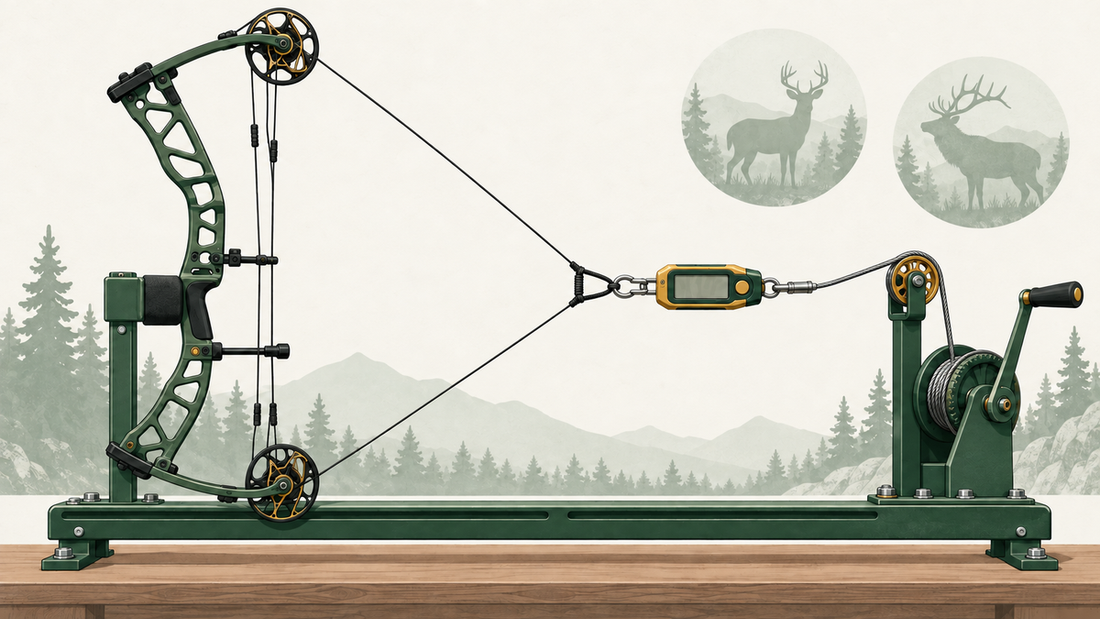
- Measure where you are. Our guide on how to measure bow draw weight shows how to use a bow scale at your own draw length.
- Increase in 3 to 5 pound steps: a turn or two of the limb bolts on a compound, a new set of limbs on a recurve.
- Pass the hold test first: draw, anchor and hold for ten seconds without shaking, then shoot 30 arrows with the same form as the first.
- Check that the bow fits. The compound bow size chart covers draw length and axle-to-axle length.
- Give it six to eight weeks per step. Draw weight you cannot hold in the cold from a treestand is not draw weight you own.
How to confirm you are legal before opening day
If you plan to practice at home, check whether it is legal to shoot a bow in your backyard. Those rules come from your city, not the wildlife agency.
Ethics come before the minimum
- Know your effective range: the distance where every arrow stays in a 6 inch circle, in hunting clothes, from the position you will shoot
- Match the bow to the animal, not to the legal floor
- Use a sharp broadhead and check it before every sit
- Take broadside or quartering-away shots only
- Wait for the animal to be calm and inside your range, or let it walk
A legal bow with a rushed shot at 40 yards wounds more deer than a light bow used well at 15.
Related guides
Tools and charts for getting the bow, the arrow and the distance right.
Frequently asked questions
Short answers to common questions about minimum draw weight for bow hunting.
What is the minimum draw weight for bow hunting deer?
Where a legal minimum exists it is usually between 30 and 45 pounds, and some states set none. Practically, plan on 40 pounds with a compound or 45 to 50 with a recurve or longbow, and shots inside 25 yards.
Is 40 lb draw weight enough for deer?
Yes with a compound, a 350 grain or heavier arrow and a fixed-blade broadhead, out to about 25 or 30 yards. With a recurve, 40 pounds is a short-range deer bow that needs a heavy arrow.
Can you hunt deer with a 30 lb bow?
Legal in some states, not in others, and marginal either way. A 30 pound compound makes roughly 27 foot-pounds, so limit it to broadside shots under 15 yards. A 30 pound recurve should stay on small game.
What draw weight do you need for elk?
Plan on 55 to 65 pounds, an arrow of 450 grains or more, and at least 42 foot-pounds of kinetic energy, with 55 to 65 a comfortable target. Elk bone and hide are far tougher than deer.
What is the minimum draw weight for a hunting crossbow?
Where states set one, crossbow minimums commonly fall between 75 and 125 pounds, and most hunting crossbows are well above that. Some states also set minimum bolt length, require a working safety, or cap the maximum.
Is draw weight measured at 28 inches or at my draw length?
It depends on how your state writes the rule. Some measure at 28 inches, some at the archer's own draw length, and some do not say. Weigh your bow both ways if you are close to the line.
References
These sources support the guidance on this page.