Youth Bow Fitting: More Than an Age Chart
By James Holbert · Explained Archery
Fit a youth bow to the child's present draw length, manageable draw weight, hand size and ability to control the whole bow. Age helps describe the learner; it is not a safe sizing formula. A bow with room to adjust can be useful, but it must already fit at its current setting—not become suitable only after the child grows.
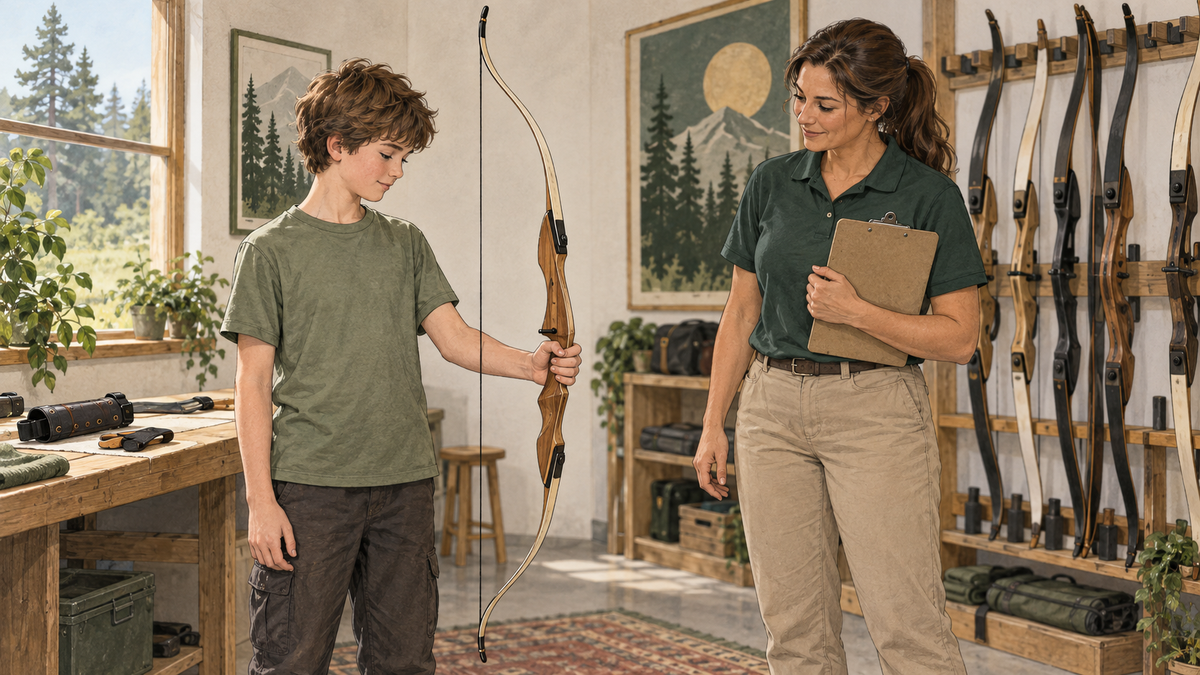
Why an age-only youth bow chart falls short
Two children of the same age can have different reach, strength, coordination and experience. A taller beginner may still need a lighter bow than a smaller experienced archer. Conversely, a low draw-weight label does not help if the bow is too physically heavy to hold or the grip is too bulky.
Use age to check a club's participation policy and a manufacturer's stated restrictions. Use measured fit and supervised control to select equipment. This guide intentionally does not assign poundage to birthdays.
| Check | What you need to know | A reason to change the setup |
|---|---|---|
| Readiness and supervision | Can the learner follow stop, wait and retrieval instructions? | Range commands cannot yet be followed consistently. |
| Shooting side | Comfortable drawing hand and usable aiming eye | Equipment chosen only because that handed version was available. |
| Draw length | Coach-observed reach at a repeatable anchor | Stretching, leaning or an unsuitable compound draw stop. |
| Draw weight | Controlled draw, aim and let-down over a short session | Jerking, sky-drawing, collapsing or strain. |
| Physical bow mass and grip | Comfortably supports the assembled bow | Shoulder hikes up, wrist contorts or the bow quickly sags. |
| Arrow fit | Safe length, suitable spine, mass and nock fit | Arrow becomes too short at full draw or mismatched after adjustments. |
A first fitting appointment: six steps
1. Start with a supervised lesson
Borrow club equipment before committing to a purchase. Tell the instructor about previous experience and the intended activity: casual target practice, a school programme or a particular club discipline. Programme equipment rules may affect the choice. World Archery recommends introductory instruction and coach advice before buying; it also notes the value of rental beginner limbs.
2. Establish handedness without forcing it
A right-handed bow goes in the left hand. Check eye dominance and bow handedness, then let the instructor assess a comfortable shooting side. Do not use a child's writing hand or one quick eye test as the entire fitting process.
3. Measure draw length in a controlled setting
A wingspan estimate can help prepare for the appointment, but it is not an arrow-cutting instruction. Have a coach or shop measure draw length with suitable equipment and sound form. Record which measurement convention was used. See how draw length is measured.
Do not have a child draw a real bow without an arrow for a living-room measurement. Use a training device, or let the instructor manage the measurement on a safe range. All actual shooting and loaded draw checks require a suitable target, clear range and direct supervision.
4. Choose weight the child controls now
Distinguish draw weight, the force needed to pull the string, from bow mass, the weight of the bow and accessories in the hand. Both can be too much. Start with a light loaner setting, not the highest number the child can pull once.
During supervised shooting, watch for a smooth level draw, a settled anchor and the ability to let down on command. Repeatedly leaning backward, lifting the bow skyward to pull, shaking with effort or losing control means stop and reassess. Pain is a stop signal, not a strength-building exercise. Rest before judging a different setup.
A recurve's limb label is normally tied to a reference draw length; it is not necessarily the weight this child draws. A compound's peak draw weight and holding weight after let-off are different. Low holding weight does not excuse a peak the child cannot safely pass through. Use a proper draw-weight measurement rather than guessing.
5. Check grip, clearance and arrows together
Try the bow assembled as it will be used, including the sight and other accessories. Check that protective equipment fits and clothing cannot catch the string or mechanism. A coach should check string clearance without teaching the learner to twist around poorly fitted gear.
The arrow must remain safely supported at full draw. Do not buy short arrows from an age chart or assume last season's arrows still fit. Select length, spine, point and nock for the actual setup; Genesis's safety guidance emphasizes matched arrows and checking damage. Our arrow-length guide explains why draw length and cut arrow length are not interchangeable.
6. Record the setup and its adjustment limits
Ask the shop to write down the current setting, measured draw weight, draw length, arrow specification and who should make later changes. Find out whether adjustment requires replacement modules, compatible limbs or a press. “Adjustable” does not mean every parent should turn every screw.
Recurve, adjustable compound or club training bow?
| Option | What to assess | Do not assume |
|---|---|---|
| Light takedown recurve | Grip, physical mass, draw comfort and compatible replacement limbs | All limbs fit all risers, or marked poundage equals the child's actual draw weight. |
| Adjustable compound | Current draw length, peak weight, let-down control and supported adjustment range | The advertised minimum weight is available at every draw length. |
| Club or school training bow | Programme rules, instructor support and model-specific fit | A shared-use design has no maximum draw length or other limits. |
For example, the Genesis FAQ distinguishes its models and describes universal-draw-length designs; that does not make every youth compound equivalent. Read the exact model's manual and adjustment chart. A familiar club model that fits today can be more useful than a feature-heavy bow bought for imagined future strength.
The recurve size guide and compound size guide explain different dimensions. Neither should replace the supervised checks above.
Plan for growth without overbowing
Buy adjustment headroom, not excessive current weight or draw length. Ask about a limb-rental, exchange or trade-in scheme. Include instruction, a safe practice venue, arrows and protection in the budget before optional accessories.
Recheck fit after noticeable growth, a technique change, altered bow settings or signs of fatigue that were not there before. An increasing draw length can change both the load on a recurve and the safe arrow-length margin. Reassess the arrows whenever the bow setup changes; do not simply turn up the weight and keep everything else.
Take this record home
- Bow make, model, RH/LH designation and manual location.
- Measured draw length and draw weight at the present setup.
- Current limb/module settings and permitted adjustment limits.
- Arrow model, spine, length convention, point mass and nock type.
- Coach/shop contact, fit-check date and reason for the next review.
Keep practice short enough that the child can still follow instructions and control the bow. Enjoyment and consistent safe habits matter more than reaching a poundage milestone. For the rest of the kit, use the beginner equipment checklist.
Common questions
What size bow does a ten-year-old need?
Age alone cannot determine it. Establish shooting side, measured draw length, manageable draw weight, grip comfort, bow mass and safe arrow fit with an instructor.
Should I buy a stronger bow for a child to grow into?
No. Choose equipment that fits and is controllable now. A verified adjustment range or a future limb exchange is a better growth plan than excessive present draw weight.
Can siblings share a youth bow?
Only if each child's handedness, fit, arrow requirements and control are checked. Any adjustment between users must follow the manual; the same age or height does not establish compatibility.
How often should youth bow fit be checked?
Reassess after growth, technique or equipment changes and whenever control or comfort worsens. Check equipment condition before every session and use the instructor's follow-up plan.